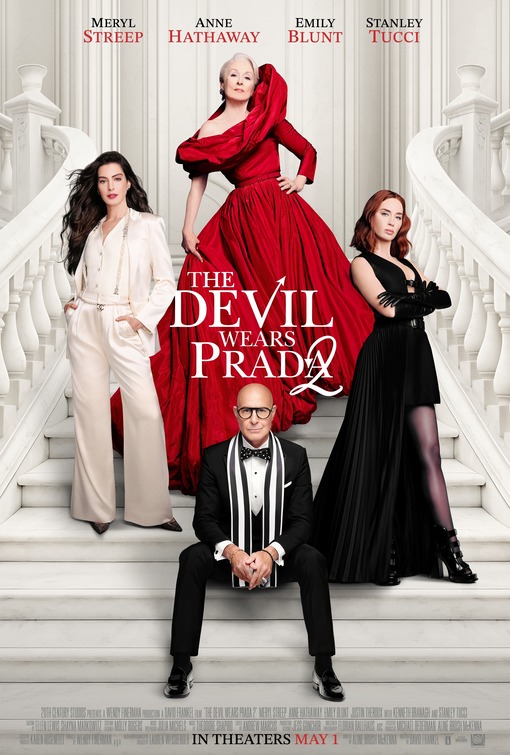
Twenty years after audiences first met the iconic Miranda Priestly (Meryl Streep) in “The Devil Wears Prada,” the long-awaited sequel has finally arrived. Yet, in a period when Hollywood often relies on hollow sequels and reboots, I felt that the film was less like an earned return and more like a superficial attempt to milk past success.
The sequel differs from the original mainly through its updated themes, which have been modified for a more modern audience. While its predecessor focuses on the pressure of starting a career in a toxic workplace, “The Devil Wears Prada 2” explores the decline of physical media and the influence of social media, following Andy Sachs (Anne Hathaway) as she fights to keep Runway magazine relevant in a technology-dominated era. Other characters join her, including Emily Charlton (Emily Blunt) as a Dior senior executive and Nigel (Stanley Tucci) as Miranda’s loyal right-hand man.
These new themes result in a handful of humorous moments, like when Runway encounters a public relations crisis caused by TikTok influencers, leading to the creation of various AI-generated memes centered on Miranda. The film also features real-life influencers, including online personality Caleb Hearon, playing a genuine role as Miranda’s assistant. I found these cameos to be both enjoyable and an effectively subtle commentary on how these motifs are prevalent outside of the fictional world.
I found that these topics added relevance to the movie, making it feel more compelling to an audience that has also changed since the original. They also make familiar characters like Andy Sachs and Emily Charlton confront new issues, causing the film to feel more engaging and fresh.
At the same time, “The Devil Wears Prada 2” undeniably relies heavily on nostalgia. I wanted these callbacks to feel exciting and rewarding, but after a while, they caused the movie to feel like a flatter version of the original. For example, the film opens with Andy brushing her teeth and wiping a mirror — a direct callback to the original — but it lacked the same freshness, with “Netflix lighting” giving it a superficial, lifeless feel.
While this unoriginality weakened my overall impression of the movie, strong performances from Meryl Streep and Emily Blunt kept me entertained throughout. The most enjoyable parts of the movie were character-based, such as when Nigel finally receives his long-overdue recognition and gives a keynote speech during Milan Fashion Week.
I found the weakest aspect of the movie to be its romantic storyline. Protagonist Andy Sachs enters into a relationship with an Australian contractor named Peter (Patrick Brammall). However, they lack connection and chemistry — their major conflict involves a stale job versus relationship idea that is recycled from the last movie — and the entire character just feels like an empty apology for Sachs’s first boyfriend, Nate Cooper (Adrian Grenier), who was widely considered the true villain of the original film.
Ultimately, “The Devil Wears Prada 2” succeeds more as a nostalgic reunion than a thoughtful expansion. While it cleverly weaves in modern subjects and delivers enjoyable performances, I found it lacking in visual style and originality, and as a result, it feels more like a repeat than a continuation. The movie is worth a watch for fans of the original looking for a dose of nostalgia, but new viewers seeking an innovative, standalone experience can stay home.