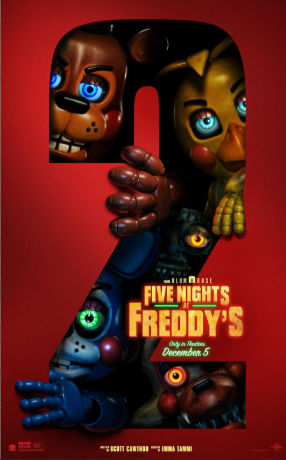
As the lights and security cameras flicker, the new Fazbear animatronics come back to life—not to play, but to deliver a confusing plot and a slice of disappointment to longtime Five Nights at Freddy’s fans.
Many were excited when the FNAF 2 movie was announced in April 2024. With its Dec. 5 release date approaching, fans’ expectations continued to rise. Sophomore Iyana Ollie, a FNAF fan, shared, “My expectations for the FNAF 2 movie are to be better than the FNAF 1 movie. Based on the trailers and spoilers I’ve seen so far, the movie seems really good.”
Senior Natalie Yap agreed. “I did watch the first FNAF movie, and I thought it was interesting. I really liked the visuals, characters, and animatronics. My expectations for FNAF 2 are a good soundtrack and visuals.”
Math teacher Bryan Chao added, “I heard FNAF 2 was supposed to be scary, so I’m looking forward to that.”
With all the excitement and expectations in mind, I felt suspense as I watched the introduction. I held my breath as Charlie ran to save a young boy after the adults failed to listen. Golden Bonnie chased her with a knife, getting closer and closer.
Seeing Charlie safely exit through the red curtain with the boy in her arms made me feel relieved—until she suddenly collapsed, revealing three red stab wounds on her back.
The introduction was an amazing start. It promised a more suspenseful and brutal tone than the first film. But something felt off: the storyline. The FNAF 2 movie doesn’t follow the established lore of the franchise.
In the FNAF 2 minigame “Take Care of the Children,” it’s shown that Charlie dies outside the pizzeria. The Security Puppet crawls outside in the rain to reach her body. In the movie, however, the Puppet rises from a trap door instead of a present, and we see it carrying Charlie’s body—visually striking, but lore-breaking.
To many fans, the story is everything. Changing it erases years of theory-building and storytelling that creator Scott Cawthon previously supported. Now, it feels like the movies are rewriting history instead of honoring it.
As the movie continued, I kept wondering if it would reconnect with the lore. After all, the FNAF franchise has lasted nearly 11 years. Fans who grew up with it want to see movies that reflect the original story. Maybe Blumhouse Productions wanted to surprise longtime fans—but changes like these need context to work.
Despite my concerns, I was still hopeful after the opening. I wanted the rest of the movie to stay mostly lore-accurate, with some new ideas. Unfortunately, it didn’t. My reaction shifted from curiosity to confusion. The story took a new direction, unrelated to the first movie or the games.
Senior Tiffany Mac shared her thoughts after watching: “At first, I didn’t expect anything high for the movie. I didn’t know how they would make it better than the first one. After watching it, it did meet my expectations, but I expected more in terms of story.”
While the movie delivered strong visuals and jumpscares, that was about it. It seemed more focused on nostalgia and fan references than actual storytelling.
Senior Kacey Tran agreed. “Compared to the first one, the horror aspect was up to my expectations. But the way they portrayed the lore of the game didn’t meet my expectations,” she said.
In the second movie, the plot centers on Vanessa’s and Charlie’s trauma, rather than the original story involving Mike, Jeremy, and Michael—key characters in FNAF lore. Their roles are largely ignored.
Other story elements are underused or forgotten. The “FazFest” scene only appears twice with little significance. There could have been more horror involving the toy animatronics attacking fans. A vague conversation between Mike and Henry hints at Charlie’s importance, but her death is hardly mentioned again.
Toward the end, the Puppet is shown to have a deep grudge against adults for ignoring Charlie. Yet suddenly, Michael Afton—William Afton’s son—has control over the animatronics. No previous scene explains how this is possible, making the twist confusing and unexplained.
The pacing is rushed. Scenes move from one location to another without giving time for buildup or payoff. Compared to FNAF 1, which had slower scenes and better story-building, this movie feels scattered.
The first movie focused on one location and stuck closely to the lore with only minor changes. The horror was secondary to the storytelling, and that’s what made it effective. It took its time to build mystery and emotion.
FNAF 2, in contrast, chases spectacle. It features multiple locations, unclear plot points, and scenes that feel like fan service. The horror is stronger, but the story is weaker.
Even though FNAF 2 disappointed me in terms of storytelling, I still appreciated its cinematic strengths. The action scenes, animatronic movements, voice acting and effects were impressive. My biggest suggestion: include a clearer plot based on the FNAF 2 lore and give more attention to key details.
In the final scene, a group of teens explores the abandoned Freddy Fazbear’s Pizzeria. They find the Golden Bonnie suit wrapped in plastic with one glowing eye, and decide to open a haunted Freddy’s attraction.
The cliffhanger sets up the FNAF 3 movie.
In all, I hope Blumhouse takes more time with the next installment—prioritizing storytelling while still rewarding fans with subtle references. If they get the balance right, maybe FNAF 3 can deliver the film longtime fans have been waiting for.