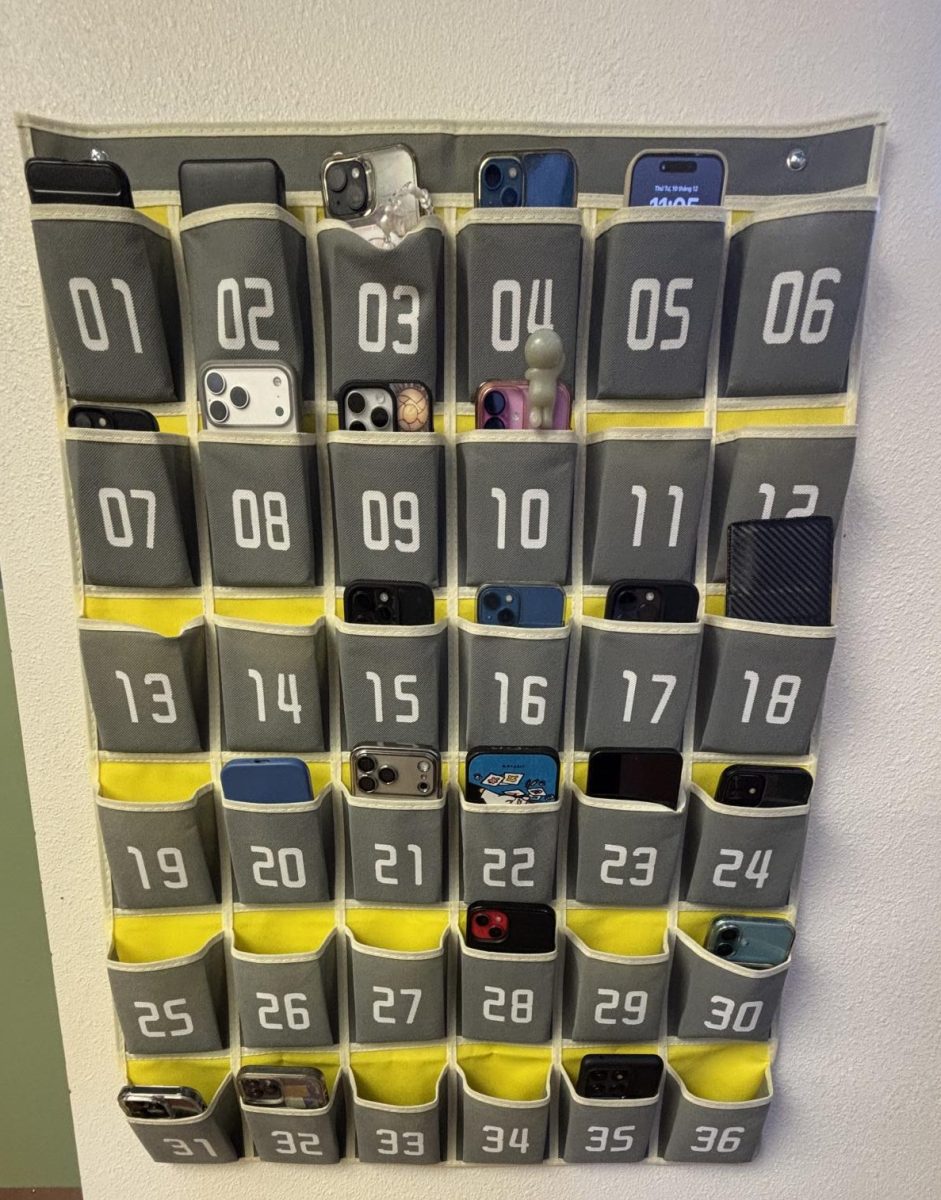
Administrators at Gabrielino High School are discussing a new policy to limit phone usage during school hours in response to growing concerns regarding student focus, classroom distractions and learning outcomes. The policy, which must be adopted by July 1, 2026, would apply to all areas of campus during class time. School officials are currently reviewing five distinct enforcement models, ranging from low-cost rules to high-tech storage systems.
Model 1 is one of the least expensive options. It requires students to keep their phones off and in their backpacks during class while still allowing use during passing periods and lunch. However, this model relies heavily on teachers constantly monitoring students, making it difficult to enforce consistently across campus.
Model 2 involves classroom phone storage pockets, where students place their devices inside a clear hanging organizer at the beginning of each class. This gives teachers a clear view of students’ phones. A drawback to this model is the potential for classroom congestion at the start of the period, which could cut into instructional time.
Model 3 proposes creating “phone-free learning spaces.” Under this plan, phones would be turned off in all classrooms but allowed in specific areas such as libraries, assemblies and lunch zones. Proponents suggest this model could increase social interaction and improve mental wellness, though it would require constant supervision from staff members to be effective.
Model 4 introduces locking phone pouches for every student. Phones would be locked upon entry to the school and unlocked at the end of the day. This option offers a physical barrier to use and minimizes classroom distractions without requiring constant teacher monitoring. However, the cost of providing pouches for the entire student body is a major concern.
The most restrictive option, Model 5, includes high-control technology such as phone lockers and Wi-Fi blocking. While this model offers maximum enforcement, it is the most expensive option and raises concerns regarding student privacy.
Students have mixed reactions to the proposed changes. Dominick Hernandez, a junior, expressed skepticism about the policy’s potential to improve learning outcomes.
“If a student really cares about school, having a phone or not wouldn’t really matter,” Hernandez said. “If a student doesn’t really care, taking their phone away won’t really solve that issue.”
Hernandez believes the student body will eventually adjust, noting that most students would be “upset for a couple of weeks until it’s just normal for them.” However, he added that if he could change one thing, it would be “not having [the policy] at all.”
Conversely, Ayden Gonzalez sees potential long-term benefits, admitting that phones can be a significant distraction.
“Most students that do worse on assignments or tests are on their phone the whole class,” Gonzalez said. “If we take that away, those students will focus more and improve.”
While Gonzalez acknowledged that the adjustment period might be difficult and make students unhappy, he supports the restrictions.
“I get distracted very easily when I have my phone on me,” he said. “Taking that away would be a positive thing even if deep down I don’t want it.”
As the July 2026 deadline approaches, school administrators will continue reviewing these models. They plan to gather feedback from students, teachers and parents through surveys before making a final decision on how phones will be handled during the school day.